History of the August and “The Roses of Heliogabalus”

The successor of Nero and Caligula, the 23rd Roman Emperor Elagabalus was spoiled since childhood. His name has become synonymous with the perversion of character, cruelty and blind adherence to lust. Strictly speaking, he was spoiled, not yet born – because he was conceived, brought up and grew up in a social paradigm that distorts his contemporaries.

Elagabalus was a worthy son of his era, from childhood he was taught that he can do anything. He wore women’s robes, was publicly exposed, was defiantly bisexual, slept with male slaves. Proudly declared that even the corrupt women did not have as many lovers as he. At the same time, by the time he was 19 years old (G.J. 203-222 AD), he had already been married five times. He openly considered honest people to be lost, and deceit and promiscuity in connections was a virtue.

The highest chic of that time was considered to sleep with a slave and then kill him. He also had a peculiar behavioral code – indicative of the fact that he was rather orderly. For example, Elagabalus daily gave something to his friends, all the time supposedly for some evil deed – he left good gifts without a gift. He made strange lotteries where he could win ten camels and ten pounds of gold — or ten flies and ten pounds of lead. At dinner, the “golden boy” ate camels’ heels, peacocks and nightingale tongues and crests cut from live roosters.

Elagabalus was so absorbed in pleasures that his mother, Julia Soaemias, and her grandmother, Julia Meza, were responsible for state affairs. Young emperor was not embarrassed in any way – he allowed them to be present in the Senate and to vote, which was previously not accepted. Quite bizarrely, a kind of “democracy” was woven into the postulates and behavioral norms of Elagabalus – he gave Senate posts, regardless of age or social origin of the candidates.

The Roses of Heliogabalus- Sir Lawrence Alma-Tadema (1888)

“The Roses of Heliogabalus” – painting by English artist Lawrence Alma-Tadema, written in 1888. According to some, this canvas is filled with the spirit of human suffering, while according to others it is a fake historical-literary. Despite the opinions of historians that this is just a fake legend, this piece of art won’t leave you indifferent.

The product in pastel tones with the predominant pink is written about death, and, to put it more clearly, about multi-death, group murder. For the basis, Alma-Tadema took the plot, from a historical point of view, dubious – “The History of August.” It described how during the feast the Roman emperor Elagabalus ordered the killing of his enemy guests, sprinkling them with roses from the ceiling. From the smell of roses, guests had to suffocate.

The main character can be seen in the background in a golden diadem, reclining in a golden mantle (or robe) on pillows next to his mother Julia. Farther visible is the statue of Dionysus – her Tadema was painted from the original kept in the Vatican Museum. Some critics perceive the sculpture as a symbol of ridicule, evil irony over the plot depicted – the Greek god looks at all this “chaos” and laughs happily (however, this is only the personal opinion of critics).
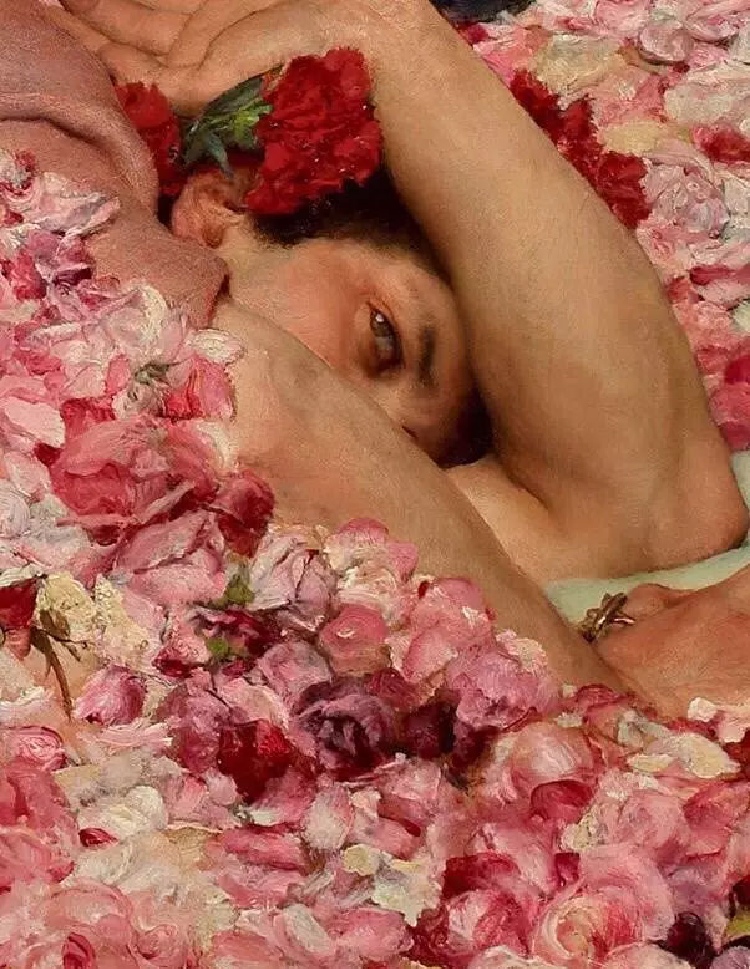
The emperor with undisguised curiosity observes the creation of his hands – the slow and painful death of guests from roses falling from an awning suspended from the ceiling and then released by the executioner into a free and deadly fall. The boy is the only male in the company of ladies. According to legend, his goal was to poison the guests with the smell of roses – and it was the pink mass that was the first to strike the eye and occupy the prevailing area of the canvas.

At first, the guests were surprised at the sudden pink waterfall, then they were delighted, but the roses continued and continued to pour in, and this cruel joke gradually began to bother and then scared. And then they all died. At the same time, the organizers of the massacre are located on a kind of “captain’s bridge”, observant bed, full of gloating. They seem to be watching a fascinating performance, which they themselves orchestrated, they are full of pride.
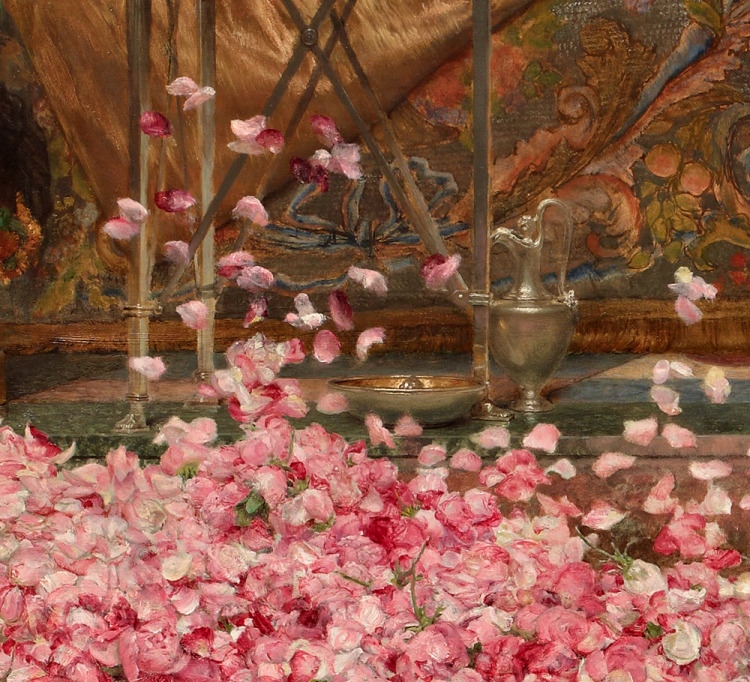
According to historians, the artist painted a picture in the winter, and for four months each week, he ordered fresh roses in the French Riviera, controlling the liveliness of each petal. With that, one of the tasks of the master was to bring into the canvas the spirit of rotting and decomposition – like roses, like the people who died from them.

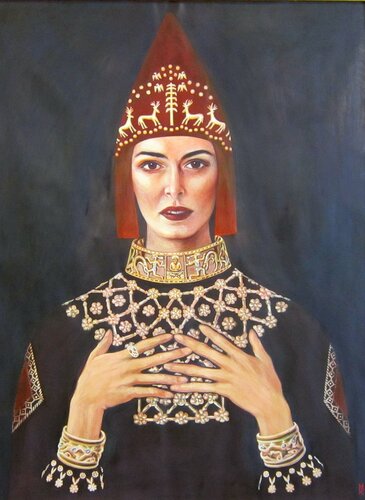
Amaga, Sarmatian Queen

After defeating the Amazons in the battle on the River Fermodonte, the Hellenic warriors on three ships, together with the captives, sailed to their homeland. But in the sea, the Amazons killed their winners, and since the warriors did not know the art of navigation, the ships became uncontrollable, and the winds and currents threw them onto the coast of Lake Meoti, where free Scythians lived. And from the union of the Amazons and Scythians, powerful tribes of Savromats appeared, ruled by female warriors.

Reports of ancient authors about Savromats, or Sarmatians, ceased to be only a historical legend only at the end of the 19th century, when Russian archaeologists in barrows located in those lands where ancient authors placed the tribes of the sons of the Amazons, discovered female burials with military weapons.

Apparently, the first Sarmatian tribes were formed approximately in the VIII — VII centuries BC in the steppes east of the Don in the Volga region and the southern Urals. Then the Sarmatians began to penetrate into the steppes of the Black Sea region, where the Scythians reigned supreme. And in the end, the Sarmatians, as the ancient Greek historian Diodorus of Sicily writes, “devastated a large part of Scythia and exterminated the defeated people without exception, turned most of Scythia into a desert.”

Near Nizhnegorsk there has long been a huge eight meters high and eighty meters diameter Nogaychinsky barrow. Among the locals about him have long been legends about the countless treasures hidden in it, the white horse, sometimes appearing at night. The main find was the unique burial of the ancient graves of a woman.

There is a gold brooch on the buried chest, bracelets on the arms and legs. Hands rested in silver bowls. Bronze mirror. Traces of a wooden box, in which lay golden rings, incense bottles. Most of the items found are decorated with precious stones – emerald, pomegranate, chrysolite, citrine, jasper, sapphire, amber, cornelian, agate.

Such a unique mound of wealth and size could not be erected above the burial of an ordinary woman. Everything – both the hryvnia and the head decoration (symbols of high dignity), and the position of the hands in silver vessels, as if emphasizing the nobility of the buried, and, finally, the very abundance of jewelry made of gold and precious stones with a total weight of over two kilograms – suggests we have before us the burial of a queen or priestess who lived somewhere within the end of the second century BC – the first century of our era.

But one curious and intriguing coincidence with written sources attracts attention. The ancient writer Polian, who lived in the II century BC, has such a story.

…The king of the Sarmatians of Midossak had a wife named Amaga — a clever and warlike woman. Midossak himself spent all his time in riot and drunkenness, and Amaga herself repaired judgment and reprisals, repelling enemies’ raids. Her fame spread throughout Scythia.

…At first, Amaga sent an order to the Scythian king to stop their raids, but when he did not obey, she chose 120 people, strong in body and soul, gave each of three horses, and, having flown 1200 stages (190-220 kilometers) with them, suddenly appeared To the king’s court and interrupted all the guards who stood at the gate. The Scythians were dismayed by surprise and imagined that the attackers were not so much as they saw, but much more. Amaga, having burst into the palace with the detachment, killed the king and relatives and friends with him.

Sergey Y. Makhankov
“Sarmatian Queen”

According to some researchers, these events took place in 165-145 years BC. It was at this time that “our” barrow was poured – the richest of all Sarmatian kurgans uncovered on the territory of the Northern Black Sea region. And on the same land, where the rules of Queen Amaga.

Girl-bosses in Japanese history

Credits to the owner

Since ancient times, the life and social status of women in Japan have been regulated by unshakable traditions and unwritten laws: the education and training of a woman were entirely focused on her family purpose. From an early age, Japanese girls were accustomed to the idea of self-sacrifice and unselfish service to the father, husband, son.

Despite the radical changes in the 20th century, this philosophy remains very strong in modern Japan. This is manifested not only in the tradition according to which, when married, but many women also cease their labor activity, devoting themselves to family and children.

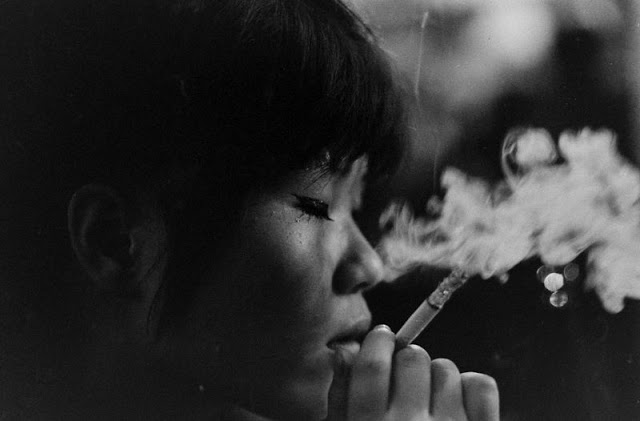
In the 1970s, the Japanese housewife stereotype began to break down. The girls began to rebel, form groups and engage in disorderly conduct, sniff glue, lead a free sex life. In school, allowed themselves daring antics.

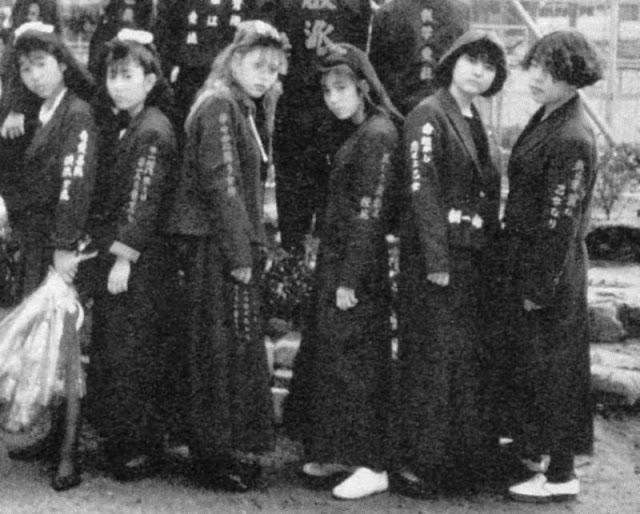
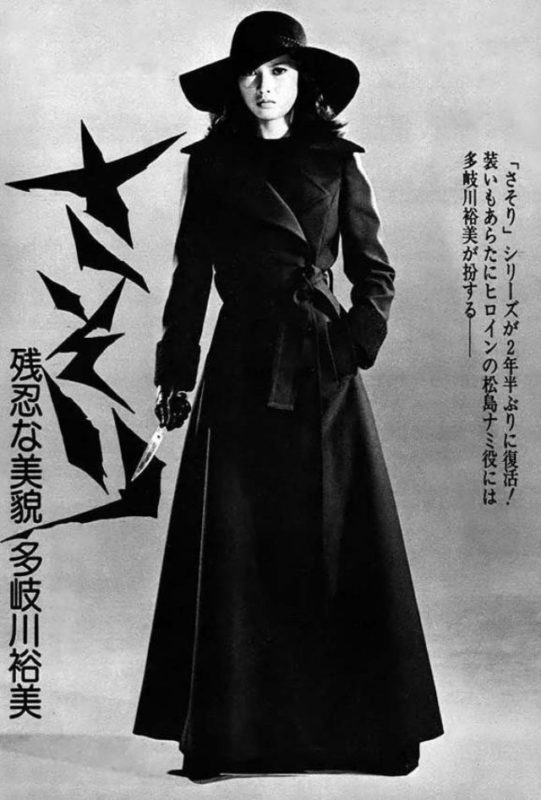
Sukeban was a real, lively subculture of rebel girls, who preferred the school uniform so as not to look like boys in leather, and were called upon to prove that girlhood and strength are not mutually exclusive.

The term “sukeban” means a bandit girl. Literally translated as “girl boss”. In the 1980s, Japanese police received a list of signs that could be used to calculate these potentially aggressive adolescents. Their school uniform had distinctive details: bright socks instead of white, rolled up sleeves, tattoos, a maxi skirt with a shortened blouse, and an embroidered grouping emblem.

Translated from Japanese, “suke” is a woman, and “ban” means “boss”. They were known for forming female gangs in which they robbed and attacked people. For the first time these groups appeared in the 1960s, and the “gang” was followed by gangs known as “Bancho”, which were joined by young men who dreamed of getting into the yakuza – the Japanese mafia.

By the 70s, the number of gangs had increased, and the sukeban girls became famous for their cruelty. The size of the groups varied from small (a group of Tokyo thieves in stores, about 80 participants) to simply huge (Women’s Delight Alliance Kanto, which, according to rumors, consisted of about 20 thousand girls throughout East Japan). Warring groups often encountered each other in fights and battles. Sukeban could sniff glue, steal heroically in stores, engage in prostitution and violence, but if they are still arrested, the police would treat them more loyal than ordinary criminals.

Each such organization had its own rather strict charter, for its violation threatened with beatings or, for example, burning with a cigarette. It was forbidden to disrespect the elders in the group, flirt with someone else’s boyfriend, friendship with a girl from another group. Even the mafia-yakuza perceived them very positively, without missing an opportunity to express approval.

However, the girls fought more for the idea. Long skirts can be seen as a reaction against the sexual revolution of the 60s, means of protection, with the help of which girls could show that their existence is not determined by the desires of men of onlookers. Fast forward to the 90s, and this trend has completely abolished itself: by that time, the “bad girl” had to wear a hundred kilograms of makeup, and the skirt hem should be as short as possible so that everyone could appreciate your indescribable sexual attractiveness.