Can I tell your story?

We love the weekends so much because this is the time when we can stop and walk along the street in a measured step. In the morning, lazily stretch, smile at the morning sunbeam and quietly drink a cup of coffee. And Sunday morning is just like  “love at first sight” (imagine here is playing a song by Etta James “A Sunday kind of love”)! And do not blame yourself that every Monday you quickly want to return to a warm and cozy weekend.

This weekend we celebrated the International Women’s Day and therefore rested much longer. I calmly walked around the bazaar, looked at the old town and drank coffee with a croissant at Starbucks. Looking through the distorted windows of a coffee shop, I had the opportunity to observe people and even come up with miniature stories for each character. This turned out to be a very entertaining exercise. Here some results.

This woman sat on the bench for about half an hour talking on her phone for a long time. By her appearance and stern expression, I concluded that she is a  businesswoman with a lot of work on her shoulders. She seemed interesting to me because she clearly and in a very focused manner wrote in her diary what her smartphone whispered in her ear. After sitting for a while, silently looking away into the distance, she got up again and ran to conquer this world!

This couple sat for a long time and chatted about “sweet nothings”. They looked at each other with such affection. Probably married for almost a lifetime! The time around them stopped and was not going to go again. Sitting and chatting, they did not need anything or anyone around in this world.

It turned out that these two love birds were the parents sitting in anticipation of their teenage daughter. She went shopping choosing her next pair of jeans and bright sweatshirts. I looked at her with kind jealousy because she was wearing a very beautiful sweatshirt of my favorite color. Looking down at her parents through her trendy glasses, she called them to walk further through the mall.

The day off is a time when you can finally meet with friends who you have promised to for a long time to find time for them. Weekends and miniature “Meeting of girlfriends.” But our gadgets won’t allow us to communicate in a reality – this is the curse of the present time.

I witnessed the first date. They were so tense and shy to look at each other and move closer than one kilometer from each other. But he bravely decided to look into her eyes and tell some joke. She liked the joke and laughed. One point counted in his favor, good job!

She started at me and looked right into my soul!

On weekends, you can also take yourself on a date, as they say, “treat yourself”! She looked at her new purchases for a long time and then delightfully put it in the bag. Finishing her frappuccino, the girl followed my example and also carefully and with interest looked at the people around her. Maybe she was looking for inspiration?

For twenty minutes, these young people looked at the Instagram of a young lady who they liked so much. A friend helped him out to make the first step. Because now it’s so hard to just ask “How are you?”.

Minutes went by like days, months, years…  She never returned, and there was no news from her either. But she promised to return. She promised that she would look at a couple of blouses in the store and quickly return to her husband. And he is faithful to her and believes in a miracle that his wife will not try on the dress.

And this is exactly the same situation just a moment right before she made a promise to return in just 15 minutes. But we all know that she will return only after she has found the right thing, which means it will not be soon.

Here no words needed. “Dear Lord, when will the baby’s parents return? I need to go to the restroom.”

It seems to me that I have a new hobby now.

History of the August and “The Roses of Heliogabalus”

The successor of Nero and Caligula, the 23rd Roman Emperor Elagabalus was spoiled since childhood. His name has become synonymous with the perversion of character, cruelty and blind adherence to lust. Strictly speaking, he was spoiled, not yet born – because he was conceived, brought up and grew up in a social paradigm that distorts his contemporaries.

Elagabalus was a worthy son of his era, from childhood he was taught that he can do anything. He wore women’s robes, was publicly exposed, was defiantly bisexual, slept with male slaves. Proudly declared that even the corrupt women did not have as many lovers as he. At the same time, by the time he was 19 years old (G.J. 203-222 AD), he had already been married five times. He openly considered honest people to be lost, and deceit and promiscuity in connections was a virtue.

The highest chic of that time was considered to sleep with a slave and then kill him. He also had a peculiar behavioral code – indicative of the fact that he was rather orderly. For example, Elagabalus daily gave something to his friends, all the time supposedly for some evil deed – he left good gifts without a gift. He made strange lotteries where he could win ten camels and ten pounds of gold — or ten flies and ten pounds of lead. At dinner, the “golden boy” ate camels’ heels, peacocks and nightingale tongues and crests cut from live roosters.

Elagabalus was so absorbed in pleasures that his mother, Julia Soaemias, and her grandmother, Julia Meza, were responsible for state affairs. Young emperor was not embarrassed in any way – he allowed them to be present in the Senate and to vote, which was previously not accepted. Quite bizarrely, a kind of “democracy” was woven into the postulates and behavioral norms of Elagabalus – he gave Senate posts, regardless of age or social origin of the candidates.

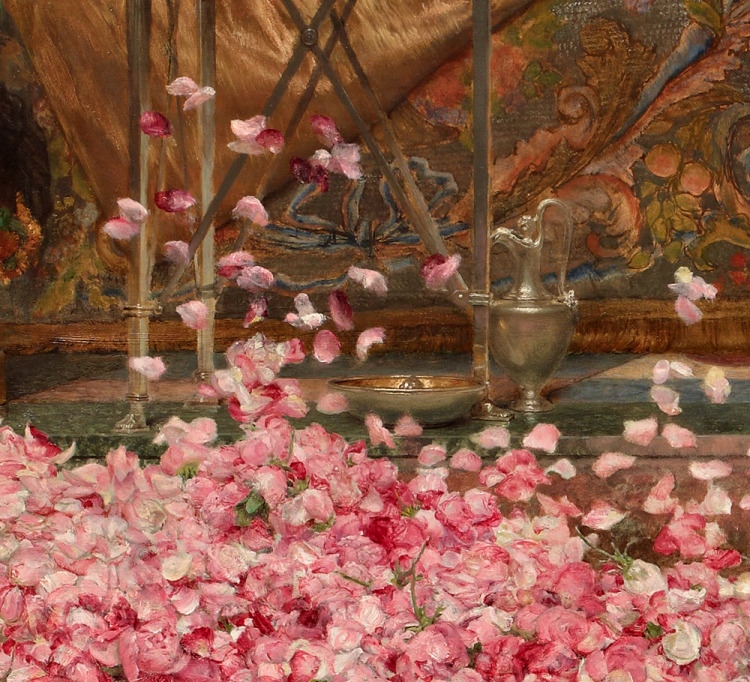
The Roses of Heliogabalus- Sir Lawrence Alma-Tadema (1888)

“The Roses of Heliogabalus” – painting by English artist Lawrence Alma-Tadema, written in 1888. According to some, this canvas is filled with the spirit of human suffering, while according to others it is a fake historical-literary. Despite the opinions of historians that this is just a fake legend, this piece of art won’t leave you indifferent.

The product in pastel tones with the predominant pink is written about death, and, to put it more clearly, about multi-death, group murder. For the basis, Alma-Tadema took the plot, from a historical point of view, dubious – “The History of August.” It described how during the feast the Roman emperor Elagabalus ordered the killing of his enemy guests, sprinkling them with roses from the ceiling. From the smell of roses, guests had to suffocate.

The main character can be seen in the background in a golden diadem, reclining in a golden mantle (or robe) on pillows next to his mother Julia. Farther visible is the statue of Dionysus – her Tadema was painted from the original kept in the Vatican Museum. Some critics perceive the sculpture as a symbol of ridicule, evil irony over the plot depicted – the Greek god looks at all this “chaos” and laughs happily (however, this is only the personal opinion of critics).

The emperor with undisguised curiosity observes the creation of his hands – the slow and painful death of guests from roses falling from an awning suspended from the ceiling and then released by the executioner into a free and deadly fall. The boy is the only male in the company of ladies. According to legend, his goal was to poison the guests with the smell of roses – and it was the pink mass that was the first to strike the eye and occupy the prevailing area of the canvas.

At first, the guests were surprised at the sudden pink waterfall, then they were delighted, but the roses continued and continued to pour in, and this cruel joke gradually began to bother and then scared. And then they all died. At the same time, the organizers of the massacre are located on a kind of “captain’s bridge”, observant bed, full of gloating. They seem to be watching a fascinating performance, which they themselves orchestrated, they are full of pride.

According to historians, the artist painted a picture in the winter, and for four months each week, he ordered fresh roses in the French Riviera, controlling the liveliness of each petal. With that, one of the tasks of the master was to bring into the canvas the spirit of rotting and decomposition – like roses, like the people who died from them.