Street art. Jean-Michel Basquiat

Jean-Michel Basquiat is a graffiti artist and neo-expressionist, a representative of the Manhattan bohemia. Today Basquiat is considered one of the most famous graffiti artists in the world. His works are sold at prestigious auctions for millions of dollars. For example, his painting Blurred Heads was sold in May 2013 at an auction in New York for $48,800,000.

“Dustheads”, 1982, by Jean-Michel Basquiat

Basquiat was born on December 22, 1960 in Brooklyn, New York. His father Gerard was from Haiti (Haitian motifs often appear in the works of the artist), his mother Matilda is from Puerto Rico. She strongly supported all the early creative endeavors of her son, contributed to his comprehensive training. Jean-Michel, in addition to English, also spoke Spanish and French, which can be traced to his works.

When the boy was hit by a car at the age of 7, his mother presented him with the reference book “Gray’s Anatomy”, so that he could understand why he was hurt. Later in the various works of Basquiat we can find references to this textbook, numerous images of human skulls. After leaving home at the age of 17, Basquiat and a friend began to paint their first graffiti, signing them with SAMO or SAMO shit (from English “same old shit” – “the same old shit”).

Jean Michel-Basquiat, Untitled (1982). Courtesy of Sotheby’s New York.

Basquiat often painted the walls not far from the Manhattan galleries or the bohemian clubs of the Soho district in order to attract the attention of “official white art”. His works were multivalued, had several semantic levels. At that time, no one did this. One day, in 1979, when he saw in the window of a New York cafe Andy Warhol, Basquiat entered and offered him to buy a postcard. Warhol liked the postcard, but the acquaintance of young people did not continue.

The relationship of artists is very influenced by the work of each other. Basquiat showed Warhol examples of his work, and Warhol shook the drawings of the young artist. It was Andy who introduced him to the very heart of America’s bohemian artistic environment. The relationship of artists continued until the death of Warhol.

Modern art critics call the work of Basquiat not graffiti, but a full-fledged wall painting. The museums are not yet resolved to represent the artistic processes of New York in the 1980s with the works of Basquiat, delicately explaining their fear of the discrepancy between the paintings of this artist and the status of museum works. A similar dual attitude to the work of Jean-Michel Basquiat was present during his lifetime.

Jean-Michel Basquiat can be attributed to the infamous Club 27. Like the other members of this conditional club, the guy was generously endowed with talents and died of a drug overdose at the age of 27. Fans of Basquiat see in his later works a premonition of death. The last work of Basquiat was “The Rider of Death”.


Can I tell your story?

We love the weekends so much because this is the time when we can stop and walk along the street in a measured step. In the morning, lazily stretch, smile at the morning sunbeam and quietly drink a cup of coffee. And Sunday morning is just like  “love at first sight” (imagine here is playing a song by Etta James “A Sunday kind of love”)! And do not blame yourself that every Monday you quickly want to return to a warm and cozy weekend.

This weekend we celebrated the International Women’s Day and therefore rested much longer. I calmly walked around the bazaar, looked at the old town and drank coffee with a croissant at Starbucks. Looking through the distorted windows of a coffee shop, I had the opportunity to observe people and even come up with miniature stories for each character. This turned out to be a very entertaining exercise. Here some results.

This woman sat on the bench for about half an hour talking on her phone for a long time. By her appearance and stern expression, I concluded that she is a  businesswoman with a lot of work on her shoulders. She seemed interesting to me because she clearly and in a very focused manner wrote in her diary what her smartphone whispered in her ear. After sitting for a while, silently looking away into the distance, she got up again and ran to conquer this world!

This couple sat for a long time and chatted about “sweet nothings”. They looked at each other with such affection. Probably married for almost a lifetime! The time around them stopped and was not going to go again. Sitting and chatting, they did not need anything or anyone around in this world.

It turned out that these two love birds were the parents sitting in anticipation of their teenage daughter. She went shopping choosing her next pair of jeans and bright sweatshirts. I looked at her with kind jealousy because she was wearing a very beautiful sweatshirt of my favorite color. Looking down at her parents through her trendy glasses, she called them to walk further through the mall.

The day off is a time when you can finally meet with friends who you have promised to for a long time to find time for them. Weekends and miniature “Meeting of girlfriends.” But our gadgets won’t allow us to communicate in a reality – this is the curse of the present time.

I witnessed the first date. They were so tense and shy to look at each other and move closer than one kilometer from each other. But he bravely decided to look into her eyes and tell some joke. She liked the joke and laughed. One point counted in his favor, good job!

She started at me and looked right into my soul!

On weekends, you can also take yourself on a date, as they say, “treat yourself”! She looked at her new purchases for a long time and then delightfully put it in the bag. Finishing her frappuccino, the girl followed my example and also carefully and with interest looked at the people around her. Maybe she was looking for inspiration?

For twenty minutes, these young people looked at the Instagram of a young lady who they liked so much. A friend helped him out to make the first step. Because now it’s so hard to just ask “How are you?”.

Minutes went by like days, months, years…  She never returned, and there was no news from her either. But she promised to return. She promised that she would look at a couple of blouses in the store and quickly return to her husband. And he is faithful to her and believes in a miracle that his wife will not try on the dress.

And this is exactly the same situation just a moment right before she made a promise to return in just 15 minutes. But we all know that she will return only after she has found the right thing, which means it will not be soon.

Here no words needed. “Dear Lord, when will the baby’s parents return? I need to go to the restroom.”

It seems to me that I have a new hobby now.

History of the August and “The Roses of Heliogabalus”

The successor of Nero and Caligula, the 23rd Roman Emperor Elagabalus was spoiled since childhood. His name has become synonymous with the perversion of character, cruelty and blind adherence to lust. Strictly speaking, he was spoiled, not yet born – because he was conceived, brought up and grew up in a social paradigm that distorts his contemporaries.

Elagabalus was a worthy son of his era, from childhood he was taught that he can do anything. He wore women’s robes, was publicly exposed, was defiantly bisexual, slept with male slaves. Proudly declared that even the corrupt women did not have as many lovers as he. At the same time, by the time he was 19 years old (G.J. 203-222 AD), he had already been married five times. He openly considered honest people to be lost, and deceit and promiscuity in connections was a virtue.

The highest chic of that time was considered to sleep with a slave and then kill him. He also had a peculiar behavioral code – indicative of the fact that he was rather orderly. For example, Elagabalus daily gave something to his friends, all the time supposedly for some evil deed – he left good gifts without a gift. He made strange lotteries where he could win ten camels and ten pounds of gold — or ten flies and ten pounds of lead. At dinner, the “golden boy” ate camels’ heels, peacocks and nightingale tongues and crests cut from live roosters.

Elagabalus was so absorbed in pleasures that his mother, Julia Soaemias, and her grandmother, Julia Meza, were responsible for state affairs. Young emperor was not embarrassed in any way – he allowed them to be present in the Senate and to vote, which was previously not accepted. Quite bizarrely, a kind of “democracy” was woven into the postulates and behavioral norms of Elagabalus – he gave Senate posts, regardless of age or social origin of the candidates.

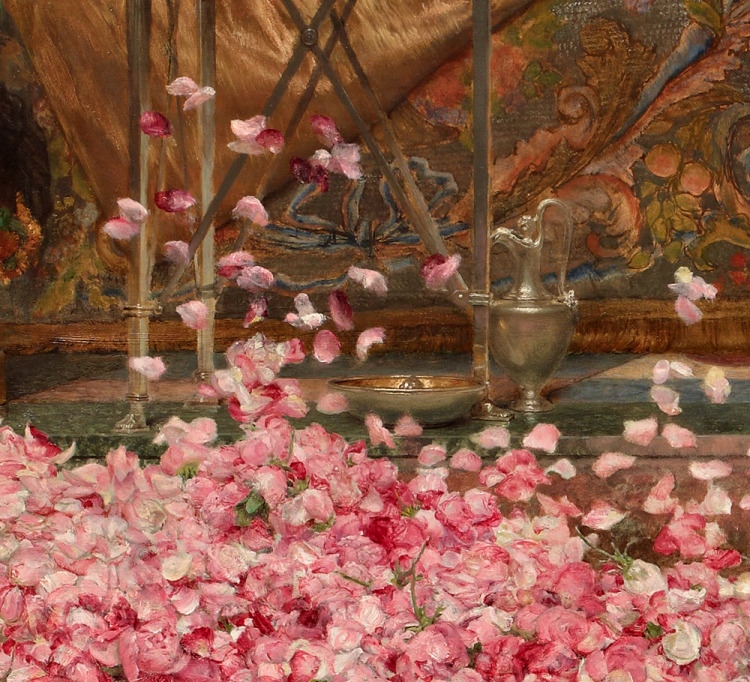
The Roses of Heliogabalus- Sir Lawrence Alma-Tadema (1888)

“The Roses of Heliogabalus” – painting by English artist Lawrence Alma-Tadema, written in 1888. According to some, this canvas is filled with the spirit of human suffering, while according to others it is a fake historical-literary. Despite the opinions of historians that this is just a fake legend, this piece of art won’t leave you indifferent.

The product in pastel tones with the predominant pink is written about death, and, to put it more clearly, about multi-death, group murder. For the basis, Alma-Tadema took the plot, from a historical point of view, dubious – “The History of August.” It described how during the feast the Roman emperor Elagabalus ordered the killing of his enemy guests, sprinkling them with roses from the ceiling. From the smell of roses, guests had to suffocate.

The main character can be seen in the background in a golden diadem, reclining in a golden mantle (or robe) on pillows next to his mother Julia. Farther visible is the statue of Dionysus – her Tadema was painted from the original kept in the Vatican Museum. Some critics perceive the sculpture as a symbol of ridicule, evil irony over the plot depicted – the Greek god looks at all this “chaos” and laughs happily (however, this is only the personal opinion of critics).

The emperor with undisguised curiosity observes the creation of his hands – the slow and painful death of guests from roses falling from an awning suspended from the ceiling and then released by the executioner into a free and deadly fall. The boy is the only male in the company of ladies. According to legend, his goal was to poison the guests with the smell of roses – and it was the pink mass that was the first to strike the eye and occupy the prevailing area of the canvas.

At first, the guests were surprised at the sudden pink waterfall, then they were delighted, but the roses continued and continued to pour in, and this cruel joke gradually began to bother and then scared. And then they all died. At the same time, the organizers of the massacre are located on a kind of “captain’s bridge”, observant bed, full of gloating. They seem to be watching a fascinating performance, which they themselves orchestrated, they are full of pride.

According to historians, the artist painted a picture in the winter, and for four months each week, he ordered fresh roses in the French Riviera, controlling the liveliness of each petal. With that, one of the tasks of the master was to bring into the canvas the spirit of rotting and decomposition – like roses, like the people who died from them.

Branzburg vs Hayes

There has always been an uncertain attitude towards journalists. And journalists have always had difficult relationships with the outside world. But in any case, we need journalists as they are the source of all information and a filter from the flood of lies.

I was interested in one case called Branzburg v. Hayes which tells about Paul Branzburg. First of all, Paul Branzburg was a full-time reporter for the Louisville, Kentucky Courier-Journal. In the late 1960s, Branzburg began concentrating his journalistic efforts on covering the use and production of illegal drugs in the Louisville area.

On November 15, 1969, Branzburg published an article documenting how two young people produce marijuana drugs. The article said that Branzburg promised his sources that he would not provide their identities. However, later Branzburg was summoned to testify against the very incidents he had reported.

He refused to identify, but the court of the first instance denied his allegations that there was a reporter’s privilege both in Kentucky and in constitutional law. On appeal, the Kentucky Appeals Court rejected the Branzburg petition. Then Branzburg filed a lawsuit in the US Supreme Court.

Branzburg was summoned to the court to disclose the sources of a report on drug trafficking published by him, while two other applicants were summoned to testify before a grand jury about the events they observed while covering the events in Black Panther.

According to the analysis of the first amendment, the court compared the absence of the privilege of a reporter to the fact that journalists do not have greater access to public affairs than ordinary citizens. In other words, the constitution does not give journalists completely unlimited rights listed in press freedom; rather, this freedom has always contained limitations.

The court noted that the only exception in which the reporter “could claim privilege would have been if it had been possible to prove that the government had acted in bad faith, for example, seeking disclosure for the sake of disclosure and could not demonstrate a real need for testimony” or the agenda was not related with the current legal issue.

In cases of protection of its sources, the court ruled that the journalist’s interest in maintaining confidentiality will lead to the fact that many criminals will avoid judicial responsibility for their actions. While this confidentiality may be part of the freedoms hoped for by the press, the public interest in prosecuting and punishing criminals far outweighs the journalist’s interest in confidentiality.

The court came to the conclusion that it is much better to do something with a crime — for example, to bring the perpetrator to justice — than to simply write about the events that occurred in the commission of the crime.

The federal judicial system, of course, never allowed journalists to refuse to testify. Creating such a privilege would lead to the absurd conclusion that any criminal who simply spoke to a journalist could have avoided responsibility.

The Supreme Court found that the fact that journalists receive information in confidence does not give them the right to conceal this information during a government investigation. In the end, the journalists decided that they would better go to prison and be held responsible for their actions. In this case, the journalist chose to go to imprisonment rather than reveal his source of information.

Amaga, Sarmatian Queen

After defeating the Amazons in the battle on the River Fermodonte, the Hellenic warriors on three ships, together with the captives, sailed to their homeland. But in the sea, the Amazons killed their winners, and since the warriors did not know the art of navigation, the ships became uncontrollable, and the winds and currents threw them onto the coast of Lake Meoti, where free Scythians lived. And from the union of the Amazons and Scythians, powerful tribes of Savromats appeared, ruled by female warriors.

Reports of ancient authors about Savromats, or Sarmatians, ceased to be only a historical legend only at the end of the 19th century, when Russian archaeologists in barrows located in those lands where ancient authors placed the tribes of the sons of the Amazons, discovered female burials with military weapons.

Apparently, the first Sarmatian tribes were formed approximately in the VIII — VII centuries BC in the steppes east of the Don in the Volga region and the southern Urals. Then the Sarmatians began to penetrate into the steppes of the Black Sea region, where the Scythians reigned supreme. And in the end, the Sarmatians, as the ancient Greek historian Diodorus of Sicily writes, “devastated a large part of Scythia and exterminated the defeated people without exception, turned most of Scythia into a desert.”

Near Nizhnegorsk there has long been a huge eight meters high and eighty meters diameter Nogaychinsky barrow. Among the locals about him have long been legends about the countless treasures hidden in it, the white horse, sometimes appearing at night. The main find was the unique burial of the ancient graves of a woman.

There is a gold brooch on the buried chest, bracelets on the arms and legs. Hands rested in silver bowls. Bronze mirror. Traces of a wooden box, in which lay golden rings, incense bottles. Most of the items found are decorated with precious stones – emerald, pomegranate, chrysolite, citrine, jasper, sapphire, amber, cornelian, agate.

Such a unique mound of wealth and size could not be erected above the burial of an ordinary woman. Everything – both the hryvnia and the head decoration (symbols of high dignity), and the position of the hands in silver vessels, as if emphasizing the nobility of the buried, and, finally, the very abundance of jewelry made of gold and precious stones with a total weight of over two kilograms – suggests we have before us the burial of a queen or priestess who lived somewhere within the end of the second century BC – the first century of our era.

But one curious and intriguing coincidence with written sources attracts attention. The ancient writer Polian, who lived in the II century BC, has such a story.

…The king of the Sarmatians of Midossak had a wife named Amaga — a clever and warlike woman. Midossak himself spent all his time in riot and drunkenness, and Amaga herself repaired judgment and reprisals, repelling enemies’ raids. Her fame spread throughout Scythia.

…At first, Amaga sent an order to the Scythian king to stop their raids, but when he did not obey, she chose 120 people, strong in body and soul, gave each of three horses, and, having flown 1200 stages (190-220 kilometers) with them, suddenly appeared To the king’s court and interrupted all the guards who stood at the gate. The Scythians were dismayed by surprise and imagined that the attackers were not so much as they saw, but much more. Amaga, having burst into the palace with the detachment, killed the king and relatives and friends with him.

Sergey Y. Makhankov
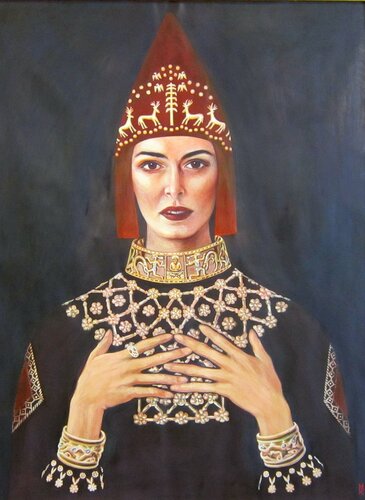
“Sarmatian Queen”

According to some researchers, these events took place in 165-145 years BC. It was at this time that “our” barrow was poured – the richest of all Sarmatian kurgans uncovered on the territory of the Northern Black Sea region. And on the same land, where the rules of Queen Amaga.